
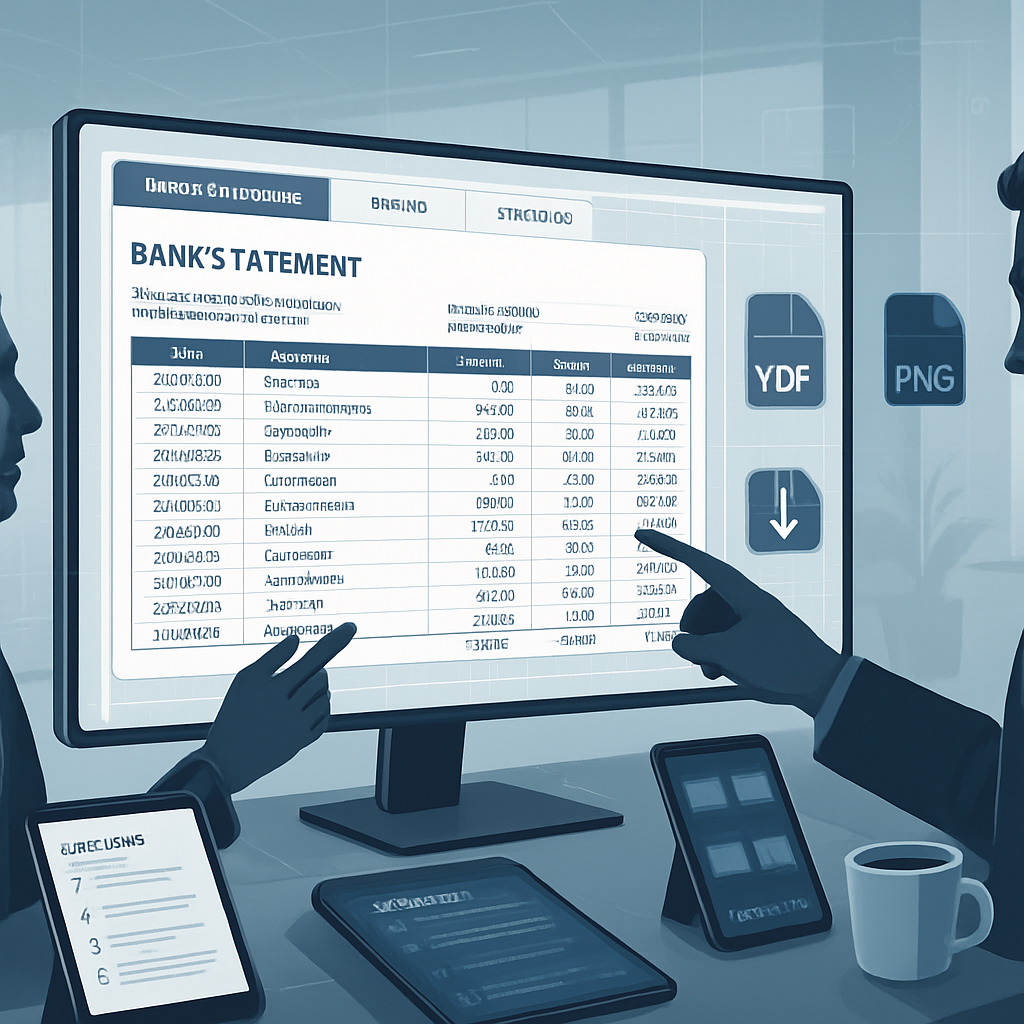
Preparing a complete set of documents can be time-consuming without the right tools, especially when consistency and clarity are essential. Using a bank statement template along with other editable KYC document templates streamlines this process, allowing you to efficiently organize financial data and supporting documents like utility bills and ID cards with clean, customizable layouts. This approach helps maintain formatting accuracy and ensures your documents export smoothly in widely used formats such as PDF and PNG.
In this guide, you’ll learn how to edit, format, and combine these editable templates into comprehensive document packs with ease. We’ll cover step-by-step instructions on customizing your bank statement sample template, integrating multiple documents, and choosing the best export settings to keep your files consistent and professional-looking. Let’s explore how adopting these templates can simplify your document preparation workflow while saving time and effort.
These templates are intended for design practice, mockups, and organizational prep; they are not substitutes for official documents.
Using a bank statement template effectively is key to assembling comprehensive KYC document packs with editable formats. This guide highlights how to integrate multiple documents like bank statements, ID cards, and utility bills for seamless preparation.
- Understand the core purpose of bank statement templates: They serve as editable bases to organize and present financial data clearly in KYC packs.
- Leverage editable templates for multiple documents: Combine bank statements, ID cards, and utility bills in one pack to streamline submissions.
- Follow structured editing steps: Customize layouts, update personal info, and maintain consistency across all KYC documents.
- Choose the right export formats: Use PDF for document integrity and PNG for image-based files to meet common verification requirements.
- Adopt best practices for document compilation: Include selfies with proper framing, clear details, and adequate lighting for ID verification.
- Hidden insight—integrate rather than isolate templates: Unlike standalone downloads, combining these editable templates into full KYC packs offers a practical advantage for end-users.
- Use trusted editable template sources: Access reliable files for each document type to save time and ensure quality in your pack preparation.
Next, we’ll explore step-by-step instructions to edit, format, and export your KYC documents properly, ensuring they meet common submission standards. These templates are intended for design practice, mockups, and organizational prep; they are not substitutes for official documents.
Understanding Bank Statement Templates in Document Packs
Editable bank statement templates serve as essential frameworks that simplify the task of organizing and presenting financial data in KYC document packs. Their primary purpose is to maintain consistency in layout and formatting across multiple bank statement versions, which saves time and minimizes errors during document preparation.
By using these templates, users can quickly input the necessary financial details—such as transaction lists, account balances, and statement periods—without reconstructing the document layout each time. This standardization is especially beneficial for institutions and individuals who manage numerous statements, ensuring clarity and easy navigation for reviewers.
Transitioning from understanding the fundamental purpose of these templates, it is crucial to explore how they integrate with other essential KYC document types in a unified document pack.
Integrating Multiple KYC Document Templates Effectively
Combining Bank Statements, ID Cards, and Utility Bills
Creating a consolidated KYC document pack requires strategic assembly of various editable templates, including bank statements, ID cards, and utility bills. The goal is to form a cohesive set that simplifies submission and enhances organizational efficiency.
One effective method involves establishing a master folder where all finalized documents are stored in standardized formats and naming conventions. This facilitates easy retrieval and smooth submission workflows.
Leveraging reliable sources offering editable templates for bank statements and utility bills can accelerate the compilation process. These sources provide a base from which documents can be customized to specific requirements without compromising on uniformity.
Choosing Suitable Templates for Each Document Type
When selecting templates, consider regional design variations to ensure relevance and acceptability. For example, editable bank statement templates tailored for North American formats differ in structure and data fields from those designed for European counterparts.
- For bank statements, prioritize templates that incorporate familiar features such as transaction tables, account summaries, and footer details specific to your banking region.
- For ID cards, choose templates accommodating standard photograph sizes, data blocks (name, date of birth, ID number), and security design elements if needed for mockups.
- Utility bill templates should reflect accurate provider branding areas, billing cycles, and table arrangements for usage details.
Ensuring compatibility in design elements — such as font types, color palettes, and margin sizes — supports a polished and professional overall pack appearance. This uniformity also aids automated systems in reading the documents accurately.
With a combined template set chosen thoughtfully, the next focus is on the actual step-by-step customization for KYC-related documents.
Step-by-Step Editing and Formatting of KYC Documents
Customizing Bank Statement Sample Templates
Editing bank statement templates demands precision to maintain authenticity in appearance while ensuring all required fields are accurate. Begin by updating personal and account details with care, using clearly named placeholder fields for efficient input.
- Replace generic headers with specific account holder names, account numbers, and contact details.
- Adjust layout elements such as column widths and row heights within transaction tables to ensure data clarity and prevent text overlap.
- Align data fields with common submission standards, which often include chronological ordering of transactions, visible statement periods, and clearly summarized totals.
To streamline this process, examine a detailed bank statement sample template such as the one available at this example. It illustrates best practices in spacing, font usage, and data placement.
Maintaining Consistency Across Documents
Consistency is key when compiling multiple documents. Synchronizing fonts — typically sans-serif types for clarity — and establishing a uniform color scheme (such as blue or black text on white backgrounds) fosters professional credibility.
Standardizing date formats is another critical detail. For instance, opting for YYYY-MM-DD helps avoid confusion across differing locale standards. Likewise, currency formatting must reflect regional conventions, including symbol placement and thousand separators.
- Use master styles for fonts and colors applied across all document templates for seamless matching.
- Align tables and text blocks using grid systems or guides to present data uniformly.
This attention to consistent styling naturally leads into considerations for exporting these documents correctly to maintain quality and compliance with submission protocols.
Recommended Export Formats for KYC Document Submission
When to Use PDF Versus PNG Formats
PDF is the preferred export format for editable, text-based documents like bank statements, ID cards, and utility bills. PDFs preserve text clarity and formatting integrity regardless of device or software used to view them. They also support embedded fonts and vector graphics, which contribute to sharp visuals and professional presentation.
PNG formats, on the other hand, are suitable for image-based files such as photos for ID verification or scanned documents. They maintain high image quality without compression artifacts but lack editable text layers.
Choosing the correct format reduces resubmission requests due to poor readability or formatting errors.
Tips for Ensuring Exported Files Meet Common Requirements
- Keep file size within prescribed limits (often 2-5 MB) to facilitate faster uploading while preserving quality.
- Use at least 300 dpi resolution for images to guarantee clarity when zoomed.
- Apply proper file naming conventions, including document type and date (e.g., “BankStatement_JohnDoe_202404.pdf”), to assist reviewers in sorting and identification.
- Double-check exported files to confirm all fonts are embedded and that no elements are cut off or improperly aligned.
Following these export guidelines primes your documents for submission success and ensures consistent presentation across viewing platforms.
With export processes refined, compiling the entire KYC document pack with complementary elements becomes the next critical phase.
Conclusion
Editable bank statement templates streamline the preparation of financial documents by providing consistent layouts and formatting, enabling efficient and error-reduced data entry. When combined thoughtfully with other KYC document types like ID cards and utility bills, these templates facilitate the creation of cohesive document packs that enhance organizational workflow and clarity.
Prioritizing regional design accuracy, uniform styling, and adherence to standardized data presentation strengthens the professional appearance and usability of each template. Careful customization paired with attention to export formats—especially PDFs for text-based files—ensures that final documents maintain integrity, readability, and meet common submission expectations.
Embracing these best practices empowers users to maintain high-quality, well-structured document assemblies that support smooth processing. As you continue refining your approach, focus on integrating reusable components and locale-correct details to boost both accuracy and efficiency in your document management efforts.